In the past few days, in the wake of the horrendous terrorist attacks in Paris, I have been confronted by the best and the worst.
On the side of the best, you have the numerous private and public messages of outrage, sympathy, solidarity, fraternity, etc., expressed loud and clear, by friends, colleagues and strangers alike.
Both in Hong Kong and Macao, the SAR governments were very prompt in issuing communiqués extending condolences to the families of the victims and wishing the injured swift recovery. In Hong Kong, an emotional vigil took place Monday evening in Tamar, gathering some 2,500, including most of the senior diplomatic representatives as well as the Hong Kong SAR Chief Executive himself. In these moments, despite adversity and distress, humanity regains its face as countless faces standing as one. I and we are together, able to commune beyond our differences.
And then, I have been witness to passing remarks made by well-intentioned acquaintances that are truly appalling, especially coming from well-educated people. One posted an emotional message on a social media platform explicitly arguing that there is somehow a “good” immigration, one that is “humble” and thus able to blend in, and… the other one. Another person, a claimed socialist, matter-of-factly told me: “well, not all Muslims are terrorists, but you cannot deny that all terrorists are Muslims!”
I am myself from Paris. My parents live near the locations that were targeted. I go to some of these places each time I am in the City of Light, and on Friday, very close friends of mine, together with their children, were supposed to go for dinner at Le Petit Cambodge and have a drink at Le Carillon. No need to say that I was thus extremely shocked by what happened, and spent most of my Saturday making sure that my loved-ones were safe. Even now, I keep peeping at the list of the victims with a clear sense of apprehension that I might stumble upon a known name. I will be in Paris for a week starting next Monday, and can already feel an immense sorrow sinking in.
Trust me, when I say I condemn the attacks and I see only criminals of the worst sort in the perpetrators of these acts – cowardly slaughtering acts – I do mean it.
Yet, one has to be careful with passing comments, especially because we have a unique responsibility in this part of the world in promoting European values and heritage. European values do not equate with Catholicism, far from it. Ancient Greece and Rome are the matrix of European civilization — Renaissance rings a bell? — and a significant part of our neoplatonic filiation only survived because of Arab intellectuals. Heritage is a bit more than street signs, and what truly matters in regards to cultural encounters is the ability to have dialogue, exchange and cross-fertilize — the rest is misplaced nostalgia.
To my Macao friends, I say it clearly as this might prove useful for this community: it is a classic phenomenon for the last wave of migrants to try to “close the door” on the next one, as it is somehow afraid the latter will challenge its hard-gained status. Discrimination against Italian and Portuguese migrants was as bad as the one against people from North-African countries, and they are all today an integral part of the French society. Beyond the international context, what is not working anymore in France is the “integration” drive, both at school and at work. Moreover, any religion is a form of ideology that can be used for different purposes, and both the Basque separatist movement ETA and the Irish IRA were packed with Catholics.
Finally, the ones who suffer the most from terrorism right now are the Muslims themselves and we are no strangers to that state of affairs.
Ultimately, it is troubling to hear senseless words from people who come from a place that has only 0.3% of Muslims… or it just proves a point: ignorance is to be fought if humanity wants to ultimately prevail.
Published in Macau Daily Times, November 20 2015
Friday, November 20, 2015

Friday, November 06, 2015
Kapok: Money matters
In any polity of the world, public spending does matter. In fact, public finance is at the crux of public policy making and constitutes a necessary reality check on the transformative power of government. With money, governments are supposed to be empowered to do aplenty, even though, ever since the 1980s, worries about misspending and plain wastefulness have fuelled questions about the right size for the state – big or small – and of course the realm and span of state capacity and action. Having money does not necessarily make one smart, quite the contrary as our Dutch friends know very well. But being too frugal, either because of a lack of means or excessive cautiousness, is equally not a guarantee of effectiveness.
The execution of the budget of the Macao government was released last week and is under scrutiny in the Legislative Assembly. It concerns only the year 2014, and this reminds us that up to two weeks ago the one institution supposed to supervise the executive regarding spending public wealth was either working on a report for 2013 – in October 2015! – or simply and blindly trusting the monthly figures from the Finance department. For reasons only known to itself, the second permanent committee of the Assembly never finds the time to scrutinise interim reports in April or May. With the unfortunate and headline-grabbing suicide of the Director-General of the Macau Customs last Friday, the discussion over the budget has faded in the distant background, whereas the Chief Executive will present his policy address on November 17.
Clearly, it deserves attention, and slightly more than eye-catching and simplistic headlines regarding supposedly astounding surplus slides or inflated concerns about allegedly exploding public expenses.
First of all, the budget tells us that the Macao government is still very rich. We have accumulated some MOP246 billion in fiscal reserve and MOP131 billion in foreign currency reserves. In 2014, despite a gambling downturn of 7 months out of 12, we managed to add a good MOP77 billion to the fiscal reserve – actually more than in 2013! Bearing in mind that the government only spent MOP67 billion even without being that mindful, it can thus continue to operate for a few years – 5 or 6 – even if it waives all taxes, including the one on gambling!
Then of course, one has to look at the execution proper and the government has been pretty consistent over the years in downplaying its expected revenues and inflating its anticipated expenses. If the gap has narrowed compared to 2013 (earning 30% more and spending 30% less!), there is still a discrepancy of 10% more for 20% less in 2014, despite a slight contraction of 2.5% in gross gaming revenues (GGR).
Of course, with an expected dive of more than 35% in GGR and more than 25% in GDP for 2015, concerns seem legitimate. And yet…. The Finance Department already tells us that as of September 2015, the government has earned far more than it has spent, and based on previous fanciful anticipations, we can conclude that as of October 2015, all the administration’s bills for the whole of 2015 are already covered!
Then comes the fallacy of lavish spending, especially on civil servants’ salaries and wealth-partaking social sweeteners. Salaries of personnel only represent 22.6% of overall spending, pretty much the same as France, clearly less than Denmark and slightly more than Hong Kong, but definitely less than anybody else as a percentage of GDP (less than 4% whereas it is 13.3% in France). Then, as an overall share of GDP, public spending represents about 15% in Macao, against close to 39% in the USA or more than 57% in France, and about 20% in Hong Kong.
Far from spending too much, the Macao government is actually spending too little, especially on public infrastructure, in all its guises. Lost opportunities and an absence of substantial investment in the future is more detrimental than lavish spending. But this grim picture concerns 2014. Since then, a new team has been ushered in…
Published in Macau Daily Times, November 6th 2015
 |
| Earning more but spending less! |
Clearly, it deserves attention, and slightly more than eye-catching and simplistic headlines regarding supposedly astounding surplus slides or inflated concerns about allegedly exploding public expenses.
First of all, the budget tells us that the Macao government is still very rich. We have accumulated some MOP246 billion in fiscal reserve and MOP131 billion in foreign currency reserves. In 2014, despite a gambling downturn of 7 months out of 12, we managed to add a good MOP77 billion to the fiscal reserve – actually more than in 2013! Bearing in mind that the government only spent MOP67 billion even without being that mindful, it can thus continue to operate for a few years – 5 or 6 – even if it waives all taxes, including the one on gambling!
Then of course, one has to look at the execution proper and the government has been pretty consistent over the years in downplaying its expected revenues and inflating its anticipated expenses. If the gap has narrowed compared to 2013 (earning 30% more and spending 30% less!), there is still a discrepancy of 10% more for 20% less in 2014, despite a slight contraction of 2.5% in gross gaming revenues (GGR).
Of course, with an expected dive of more than 35% in GGR and more than 25% in GDP for 2015, concerns seem legitimate. And yet…. The Finance Department already tells us that as of September 2015, the government has earned far more than it has spent, and based on previous fanciful anticipations, we can conclude that as of October 2015, all the administration’s bills for the whole of 2015 are already covered!
 |
| All bills covered! |
Far from spending too much, the Macao government is actually spending too little, especially on public infrastructure, in all its guises. Lost opportunities and an absence of substantial investment in the future is more detrimental than lavish spending. But this grim picture concerns 2014. Since then, a new team has been ushered in…
Published in Macau Daily Times, November 6th 2015
Friday, October 23, 2015
Kapok: Turning a blind eye
Come on, we should be gasping for breath with this Ng Lap Seng (吳立勝) story! Keeping abreast of the twists and turns in this unraveling saga of corruption involving no less than a former president of the UN General Assembly and our own high-flying real-estate developer turned power broker should leave us with Rugby World Cup-like sore eyes! Our fingers should be numb with the frenetic flicking of pages of juicy stories! Instead of that: not much, and less in Macao than in Hong Kong.

To be fair, the English and Portuguese press in Macao has been making a real effort regarding coverage, especially since the Investigative Reporting Program of University of California at Berkeley publicly released on September 29 the confidential “Final Report on a Discreet Due Diligence Investigation into Ng Lap Seng in Macau & Hong Kong,” a report that was commissioned by Las Vegas Sands to International Risk Limited back in 2010 and obtained by the program from a Las-Vegas court.
But what about the Chinese press, the one read by 95% of the population? Since Mr Ng was arrested on September 19, the Macau Daily News, the reference daily in Chinese, only published six bland short stories mentioning Mr Ng, the longest one of less than 700 characters (about 400 words)! Only the Shimin Daily (9 stories) and the San Wa Ou Daily (10 stories) seem to have done better, but yet again on the short side and certainly not in line with real reporting. More aggressive and pro-democrat small periodicals like Sonpou or Macau Concealers have provided more in-depth treatment, but mainly derived from the Hong Kong press and with a readership difficult to measure.
The Hong Kong-based Oriental Daily News and The Sun, both characterized as “pro-Beijing leftist” tabloids, published some 14 stories each! Next magazine, the pro-democrat weekly of the Next Media Group, ran its cover story on the case on October 15 and splashed 6 pages exposing possible collusion, conflict of interest and corruption with the previous Chief Executive. Even the Guangdong-based Southern Metropolis Daily published 2,700 characters of investigative reporting on October 9.
Now, what about the issue? Mr Ng, who is of course presumed innocent, is being charged in New York on at least three counts of conspiracy to bribe, bribery and money laundering in direct connection with a USD1.3 million bribery scheme targeted at the United Nations, and this on top of the charges of conspiracy to obstruct and false statements regarding USD4.5 million in cash that Mr Ng had personally funneled to the US since 2013.
And why does it matter? It has been oft repeated that Mr Ng represents Macao at the Chinese People’s Political Consultative Conference, the highest consultative body of the People’s Republic of China, is (was?) a member of the Economic Development Committee of the Macao SAR, a formal political entity directly under the Chief Executive, and also sits on the 400-member Electoral Committee that designates the Chief Executive. Mr Ng is on top of that a high-profile board member of numerous associations, in real estate, but also in education as well as community-based and patriotic organizations. Moreover, several publicly available records link his business operations to other prominent real-estate developers as well as the former Chief Executive and Stanley Ho. Finally, Mr Ng’s name has surfaced ever since the end of the 1990s in pretty noteworthy cases of traffic of influence and corruption, even though he was never convicted, in the US, but also Taiwan and Macao – including the Ao Man Long fiasco, according to a Next magazine report of August 2014. Unfortunately, the few “persons” who allegedly know this generous “human living Buddha” (sic) appear to be only talking to the foreign press…
On the side of officialdom, with the notable exception of Ho Iat Seng, the president of the Assembly, the response has been muted – what happens outside Macao does not concern Macao. Wasn’t the UN-sponsored South-South Cooperation conference center at the heart of the bribery scheme supposed to be built in Macao?

Published in Macau Daily Times, October 23 2015.

To be fair, the English and Portuguese press in Macao has been making a real effort regarding coverage, especially since the Investigative Reporting Program of University of California at Berkeley publicly released on September 29 the confidential “Final Report on a Discreet Due Diligence Investigation into Ng Lap Seng in Macau & Hong Kong,” a report that was commissioned by Las Vegas Sands to International Risk Limited back in 2010 and obtained by the program from a Las-Vegas court.
But what about the Chinese press, the one read by 95% of the population? Since Mr Ng was arrested on September 19, the Macau Daily News, the reference daily in Chinese, only published six bland short stories mentioning Mr Ng, the longest one of less than 700 characters (about 400 words)! Only the Shimin Daily (9 stories) and the San Wa Ou Daily (10 stories) seem to have done better, but yet again on the short side and certainly not in line with real reporting. More aggressive and pro-democrat small periodicals like Sonpou or Macau Concealers have provided more in-depth treatment, but mainly derived from the Hong Kong press and with a readership difficult to measure.
The Hong Kong-based Oriental Daily News and The Sun, both characterized as “pro-Beijing leftist” tabloids, published some 14 stories each! Next magazine, the pro-democrat weekly of the Next Media Group, ran its cover story on the case on October 15 and splashed 6 pages exposing possible collusion, conflict of interest and corruption with the previous Chief Executive. Even the Guangdong-based Southern Metropolis Daily published 2,700 characters of investigative reporting on October 9.
Now, what about the issue? Mr Ng, who is of course presumed innocent, is being charged in New York on at least three counts of conspiracy to bribe, bribery and money laundering in direct connection with a USD1.3 million bribery scheme targeted at the United Nations, and this on top of the charges of conspiracy to obstruct and false statements regarding USD4.5 million in cash that Mr Ng had personally funneled to the US since 2013.
And why does it matter? It has been oft repeated that Mr Ng represents Macao at the Chinese People’s Political Consultative Conference, the highest consultative body of the People’s Republic of China, is (was?) a member of the Economic Development Committee of the Macao SAR, a formal political entity directly under the Chief Executive, and also sits on the 400-member Electoral Committee that designates the Chief Executive. Mr Ng is on top of that a high-profile board member of numerous associations, in real estate, but also in education as well as community-based and patriotic organizations. Moreover, several publicly available records link his business operations to other prominent real-estate developers as well as the former Chief Executive and Stanley Ho. Finally, Mr Ng’s name has surfaced ever since the end of the 1990s in pretty noteworthy cases of traffic of influence and corruption, even though he was never convicted, in the US, but also Taiwan and Macao – including the Ao Man Long fiasco, according to a Next magazine report of August 2014. Unfortunately, the few “persons” who allegedly know this generous “human living Buddha” (sic) appear to be only talking to the foreign press…
On the side of officialdom, with the notable exception of Ho Iat Seng, the president of the Assembly, the response has been muted – what happens outside Macao does not concern Macao. Wasn’t the UN-sponsored South-South Cooperation conference center at the heart of the bribery scheme supposed to be built in Macao?

Published in Macau Daily Times, October 23 2015.
Friday, October 09, 2015
Kapok: They talk, we listen
It was an epiphany of sorts. It was some kind of astonishment mixed with a sudden surge of exasperation: they were talking, we were listening, and everything had to be absorbed to the full. The scene was taking place on the sidelines of a SJM-sponsored dinner, and the comments were made by two of the most senior managers of the company, who were obviously well sought-after by journalists in attendance.
Mr Ambrose So, SJM’s CEO, was asked to comment on the remarks made by Li Gang, the director of the China Liaison Office, which related to the fact that the central authorities would introduce policies to support Macau’s battered economy. Mr So naturally appeared very confident that it would be so—we hope that this is what he is suggesting whenever he attends a meeting of the Chinese People’s Political Consultative Conference in Beijing—and that more cities in China will open up to individual travel schemes.

Then Mr So added that it was not only a question of “numbers” but one of “quality”, as if he were remembering that a few days back, the Secretary for social affairs and culture, Alexis Tam Chon Weng, had said that “more” was not an option. In the present conditions, we seem to be stuck at 21 million mainland visitors per year. So quality it has to be, not quantity! The question for Mr So is therefore how to, and I quote, “select the quality of visitors… and to attract high-quality and high-spending visitors”. What Mr So actually means by “high-spending” is, I am sure, preferably those who are glued to the gaming table!
And then I wondered: but how could one do that and isn’t this in contradiction with several policies supported by Beijing? The central authorities and the Macau government itself are advocating for the diversification of the economy. In addition to this, if my memory serves me well, fund transfers to Macao by mainland visitors are strictly limited. And then, if the idea, just like in Bhutan, is to only attract the rich, what do we make of one of the four key components of Xi Jinping’s China Dream which is to “comprehensively build a moderately prosperous society”? Are creativity and culture only stemming from wealth? What has SJM done since it opened the Crazy Paris Show in the early 1980s to generate further interest in Macau in order to attract these premium customers—for more than one day, I mean? When was the last time diversification meant a little bit more for SJM than expanding culinary offerings, especially now that the “fish bowl” has gone? Well, the fact that Mr So defines the new game in town as developing Macao into “a center of amusement and leisure” instead of “tourism and leisure” says it all!

Published in Macau Daily Times, October 9th 2015
Mr Ambrose So, SJM’s CEO, was asked to comment on the remarks made by Li Gang, the director of the China Liaison Office, which related to the fact that the central authorities would introduce policies to support Macau’s battered economy. Mr So naturally appeared very confident that it would be so—we hope that this is what he is suggesting whenever he attends a meeting of the Chinese People’s Political Consultative Conference in Beijing—and that more cities in China will open up to individual travel schemes.

Then Mr So added that it was not only a question of “numbers” but one of “quality”, as if he were remembering that a few days back, the Secretary for social affairs and culture, Alexis Tam Chon Weng, had said that “more” was not an option. In the present conditions, we seem to be stuck at 21 million mainland visitors per year. So quality it has to be, not quantity! The question for Mr So is therefore how to, and I quote, “select the quality of visitors… and to attract high-quality and high-spending visitors”. What Mr So actually means by “high-spending” is, I am sure, preferably those who are glued to the gaming table!
And then I wondered: but how could one do that and isn’t this in contradiction with several policies supported by Beijing? The central authorities and the Macau government itself are advocating for the diversification of the economy. In addition to this, if my memory serves me well, fund transfers to Macao by mainland visitors are strictly limited. And then, if the idea, just like in Bhutan, is to only attract the rich, what do we make of one of the four key components of Xi Jinping’s China Dream which is to “comprehensively build a moderately prosperous society”? Are creativity and culture only stemming from wealth? What has SJM done since it opened the Crazy Paris Show in the early 1980s to generate further interest in Macau in order to attract these premium customers—for more than one day, I mean? When was the last time diversification meant a little bit more for SJM than expanding culinary offerings, especially now that the “fish bowl” has gone? Well, the fact that Mr So defines the new game in town as developing Macao into “a center of amusement and leisure” instead of “tourism and leisure” says it all!
As a grand finale, Mr So was asked about the recent scandals and complaints revolving around certain junket operations. For him, junkets are of a different nature at SJM and function strictly within the law. In the words of Mr So, “I checked, they do not follow that same model”. He even went as far as embracing “a more regulated market”. Again, wasn’t it Stanley Ho himself who invented the VIP junket model in the early 1980s? Isn’t this model precisely the one that allows for legally registered stakeholders to avoid responsibility and scrutiny regarding credit extension and debt collection? I guess Mr So will not be proven wrong as long as the only solution championed by the DICJ is to create a code of ethics for junkets…
Finally, Mrs Angela Leong, SJM’s managing director, rejoiced at the temporary extension of her concession to Macao’s canidrome, announcing that SJM would engage into an ambitious renovation plan “to allow for cultural developments, and to allow young people to develop their business.” There is no doubt that Mrs Leong is listening more effectively during the meetings of the government’s Cultural Industries Committee than the ones of the Legislative Assembly. In any case however, i s whistling the tune of the hour enough? The last time SJM’s parent company invested money into these dilapidated and shameful facilities was in 1998… slightly better than the 1980s!
Published in Macau Daily Times, October 9th 2015
Wednesday, October 07, 2015
Ng Lap Seng: a tale of two cities
Reading the press in English over my Timorese coffee this morning (and later on the Portuguese press… note the distinction), I really ravelled at the latest twist and turn of the Ng Lap Seng story, this pure Macao tycoon, also a member of the CPPCC and of the Economic Development Committee, who got arrested in the US two weeks ago for not properly declaring some US$4.5 million that were supposed to be used to buy arts and flats... Well, now we learn that he stands accused of bribing no less than the former president of the UN General Assembly (John Ashe) in order to have his own UN Macau Conference Center! What is really fascinating is the deafening silence of the press in Chinese in Macao... I guess years and years of ads placed by Windsor Arch, Sun Kian Ip (新建業集團) and South Bay Development Co. are ultimately bound to pay off.
Macau Daily News is clearly the worst (nothing related to Mr Ng since September 23!), but even Va Kio, San Wa Ou or Tai Chung Pou only publish very brief mentions of the big article from the Wall Street Journal that everybody is using this morning. A quick check using Mr Ng's Chinese name (吳立勝) over the past few weeks returns this:


Macau Daily News is clearly the worst (nothing related to Mr Ng since September 23!), but even Va Kio, San Wa Ou or Tai Chung Pou only publish very brief mentions of the big article from the Wall Street Journal that everybody is using this morning. A quick check using Mr Ng's Chinese name (吳立勝) over the past few weeks returns this:

The only things decent in Chinese come from the liberal press in Hong Kong (Ming Pao and Commercial Times).
If one searches 吳立勝 on Google or Baidu however, the search can return pretty interesting results. I had already mentioned two weeks ago that Sun Kian Ip had been ditched by another UN sponsored outlet called the Global Compact (the letter of commitment addressed to Ban Ki-moon himself and signed by Mr Ng is truly fascinating: "I am pleased to confirm that Sun Kian Ip Group supports the ten principles of the Global Compact with respect to human rights, labour, environment and anti-corruption"). But there is more: fascinating pics of Mr Ng and all his acquaintances in Macao can be found here and here. There is also an interesting article on Yiernews pointing to Mr Ng's buddies for the South Bay Development Co.
One of my personal favorites is this one (authorised by Chinanews; I hesitated a long time with the one of the Charity dinner given by Sun Kian Ip in 2012... but it was not Chinanews sponsored):
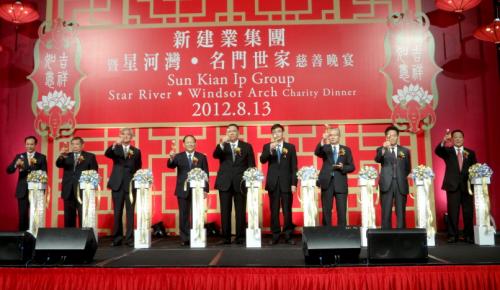

Clearly, Ho Iat Seng, the president of the Legislative Assembly in Macao and also the Standing Committee member of the National People's Congress, is arguing for a proper mechanism within the CPPCC to expel Mr Ng, if 市民日報 is to be trusted.
Subscribe to:
Posts (Atom)